
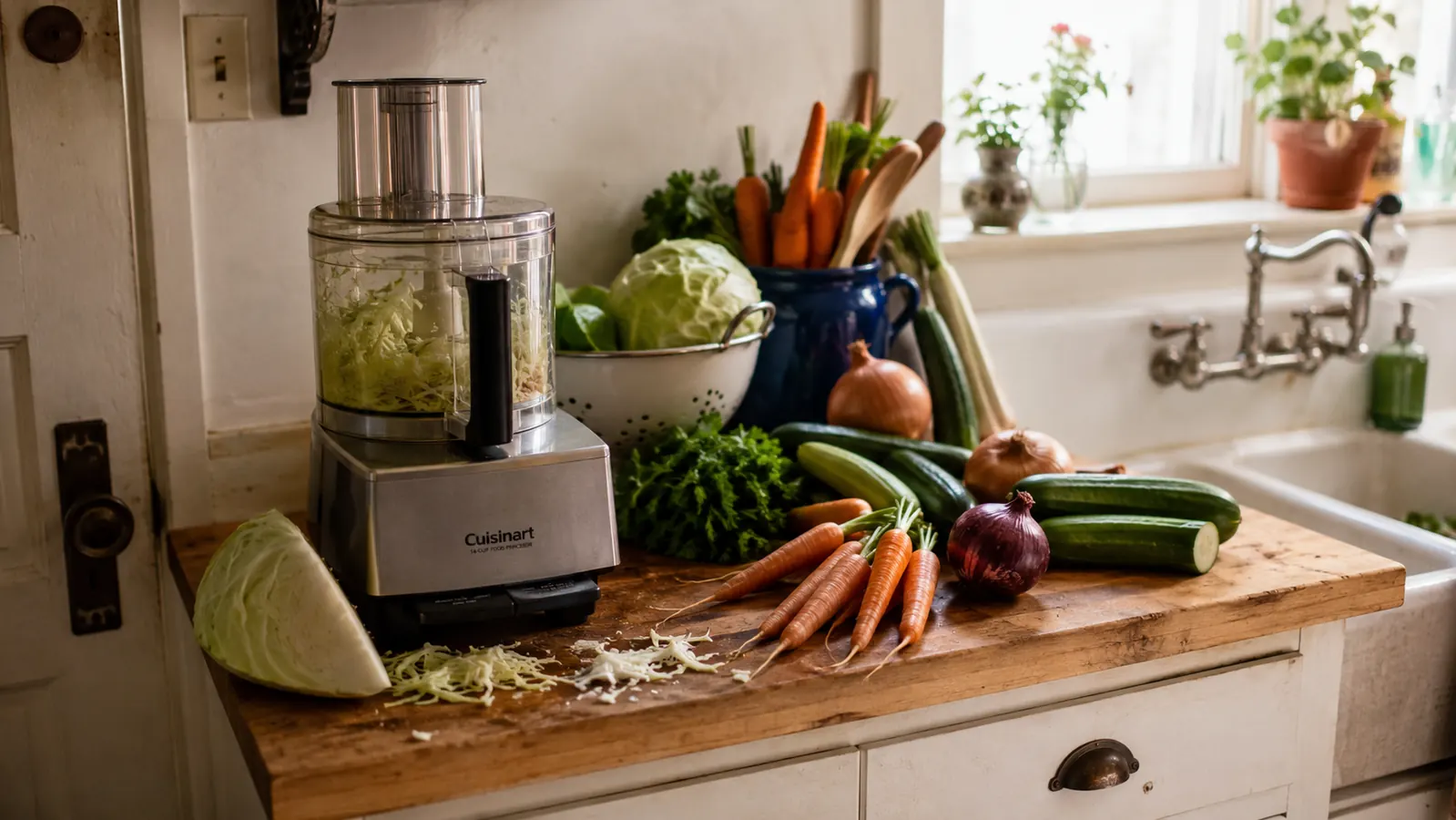
Sunday afternoon is when I actually get ahead of the week, and for the last six months that has meant hauling the Cuisinart food processor down from the top of the fridge and clearing my twenty-two inches of counter beside the sink in my 1940s upstairs duplex. I used to spend close to forty minutes with a knife working through a full week of vegetables for Paul and me. Now the Cuisinart food processor gets me through the same pile in under fifteen minutes, and this guide is the exact order and settings that make that possible, not just the claim that it's fast.
None of this is complicated, but the first few times I used the Cuisinart food processor I did it in the wrong order and ended up washing the bowl three separate times in one afternoon, once for the mild vegetables, once for the wet ones, and once for the onion and garlic that left everything else tasting like onion and garlic. There's a sequence that avoids all of that, and it comes down to running dry and mild vegetables first, wetter vegetables in the middle, and anything strong smelling dead last. It sounds like a small thing to plan around, but it's the difference between one trip to the sink at the end and three trips scattered through the whole afternoon.
Tired of losing your Sunday afternoon to a cutting board?
The Cuisinart 7-Cup Pro Classic Food Processor turns a week of vegetable prep into about fifteen minutes on the counter. See what it's doing today on Amazon before you plan your next prep day.
Amazon Check Today's Price on Amazon →Step 1: Prep in the Right Order So You Only Wash the Bowl Once
The single biggest time saver with the Cuisinart food processor isn't the motor, it's the order you feed things through it. Start with whatever is driest and mildest smelling, carrots, cabbage, celery, bell peppers. Those leave almost no residue behind and don't transfer flavor to anything that comes after them. Move to wetter vegetables next, zucchini and cucumbers, which leave some moisture in the bowl but nothing that carries a smell. Save onions and garlic for dead last, always, because those two will flavor everything that touches the bowl afterward even with a quick rinse between batches.
Doing it in that order means I run the entire week's vegetables through the Cuisinart food processor with one wipe of the bowl between vegetable types, not a full wash, and I only actually wash the bowl, blade, and disc once, at the very end after the onions and garlic are done. On a Sunday when I've got maybe twenty minutes before I want to be done in the kitchen, skipping two extra trips to the sink is the difference between finishing the job and giving up halfway through.
Step 2: Cut Everything to Fit the Narrow Feed Tube Before You Turn It On
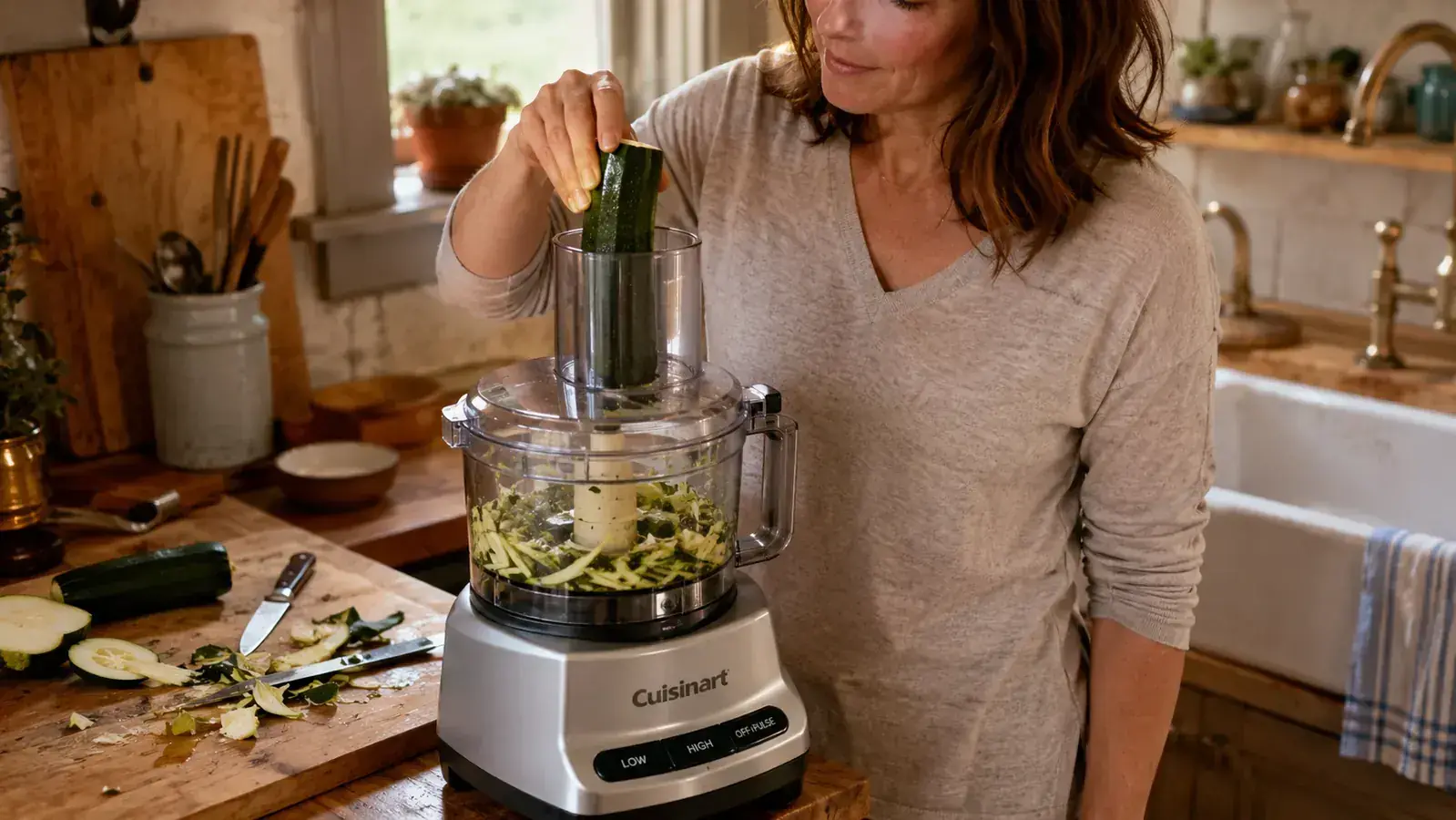
The feed tube on the Cuisinart is narrower than it looks in photos, and this is the step people skip and then fight the machine over. A whole cucumber or a whole zucchini will not drop through it. Halve them lengthwise first, on the cutting board, before anything goes near the food processor. Carrots need to be cut down to the length of the tube, usually in half or thirds depending on how long they are. Cabbage gets quartered through the core so each wedge is narrow enough to stand upright.
This adds maybe ninety seconds of knife work up front, which sounds like it defeats the purpose of using a food processor at all, but it doesn't. Cutting six vegetables down to feed-tube size takes far less time and far less wrist effort than slicing or shredding all six of them by hand, and it's the only prep step you need the knife for at all once the Cuisinart food processor is doing the actual chopping.
Step 3: Pack the Feed Tube So the Slices Come Out Even
How you pack the tube matters more than most people expect. If you drop pieces in loosely, they tip sideways as they fall and you get uneven slices, thick on one end and paper thin on the other. I stand cucumber and zucchini halves cut side down, snug against each other and against the tube wall, so there's no room for them to shift when the pusher comes down. Carrot pieces go in standing on end for the same reason. A tightly packed tube with three or four pieces gives you more consistent slices than a loosely packed tube with six.
Feed the pusher down with steady, even pressure, not a hard shove. A hard push on the Cuisinart food processor can force a piece through at an angle and you'll get one or two ragged slices at the start of a batch. Slow and steady gets you slices that all look like they came off the same cut, which matters more than it sounds like it should when you're trying to get a stir fry to cook evenly later in the week.
Step 4: Match the Blade or Disc to the Job, Not Just Whatever Is Already In
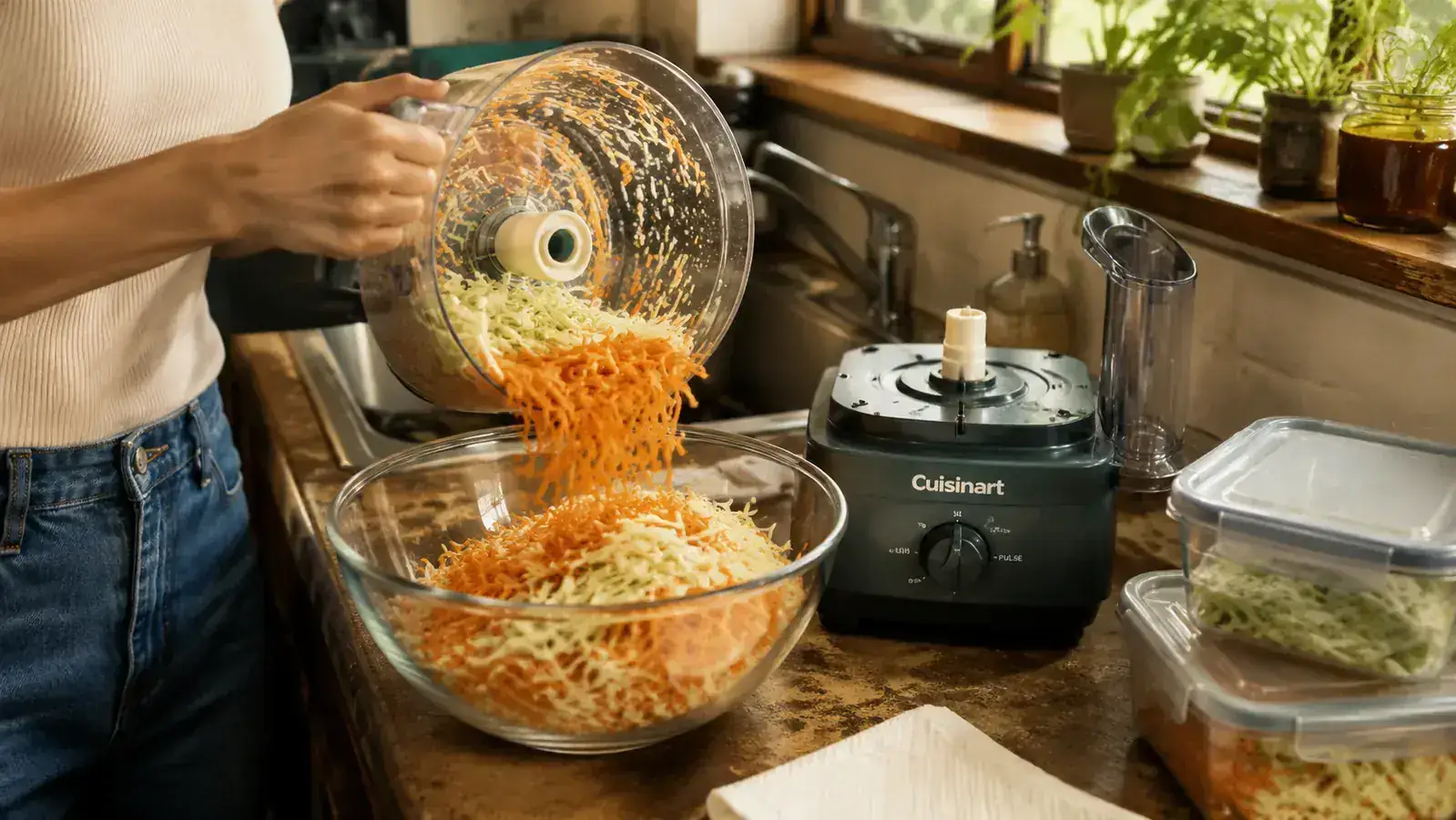
The standard S-blade is for anything you want minced or roughly chopped without a specific shape, onions, garlic, celery for soup, fresh herbs. The slicing disc is for anything you want in uniform rounds or half moons, cucumbers, zucchini, bell peppers for stir fry. The shredding disc is for anything you want in long thin strands, carrots for slaw, cabbage, and it also does a fast job on potatoes if you're making hash browns later in the week. Swapping discs takes about ten seconds once you're used to the lid, and running the wrong tool for the job is the most common reason people think the Cuisinart food processor is more trouble than it's worth.
I keep the two discs in a case in my hall closet bin along with the bowl, and I've learned to lay out which disc I need for each vegetable before I start, in the order I planned in Step 1. That way I'm not digging through the closet bin mid task with wet hands, which is exactly the kind of small friction that makes you reach for a knife instead the next time. Between disc swaps I run each one under water for a few seconds and use a small brush to clear whatever's caught in the teeth, since a sponge alone doesn't get down into those slots, and skipping that step just means a longer wash at the end.
Step 5: Pulse the S-Blade, Run the Discs Continuously
This is the setting mistake that ruins the most vegetables. If you hold the run button down on the S-blade for onions or garlic, you don't get chopped onion, you get onion paste, because the blade keeps cutting the same pieces smaller and smaller with nothing to stop it. Short pulses, one second on and off, let you check the texture between pulses and stop the moment it looks right. I use anywhere from five to eight pulses for a rough dice on an onion, tasting the texture with my eyes rather than trying to count seconds.
The slicing and shredding discs work differently and don't need pulsing at all. Because the vegetable only gets cut once as it passes the spinning disc, running the Cuisinart food processor continuously on the run setting gives you clean, even slices the whole way through the batch, with no mush risk the way there is with the blade. Pulsing a disc job just wastes time and doesn't change the result.
Step 6: Know the 7-Cup Ceiling and When to Run a Second Batch
The bowl on my Cuisinart food processor holds 7 cups, and that's generous for two people's worth of vegetables but it does have a real ceiling. A full head of cabbage shredded fills it close to the top on its own. If I'm doing cabbage and carrots and zucchini in one prep session, cabbage alone can take up most of the bowl, which means the carrots and zucchini need to go in as a second batch rather than getting dumped on top of what's already there.
I keep a large mixing bowl next to the food processor for exactly this reason. When the Cuisinart bowl gets to about three quarters full, I empty it into the mixing bowl, wipe the processor bowl out with a paper towel if needed, and keep going with the next vegetable. It adds maybe thirty seconds per swap, and it's a lot faster than trying to force too much volume through a bowl that isn't built to hold it, which just means uneven cuts on whatever gets crammed in at the top.
Step 7: Store What You Prepped So It Actually Lasts the Week
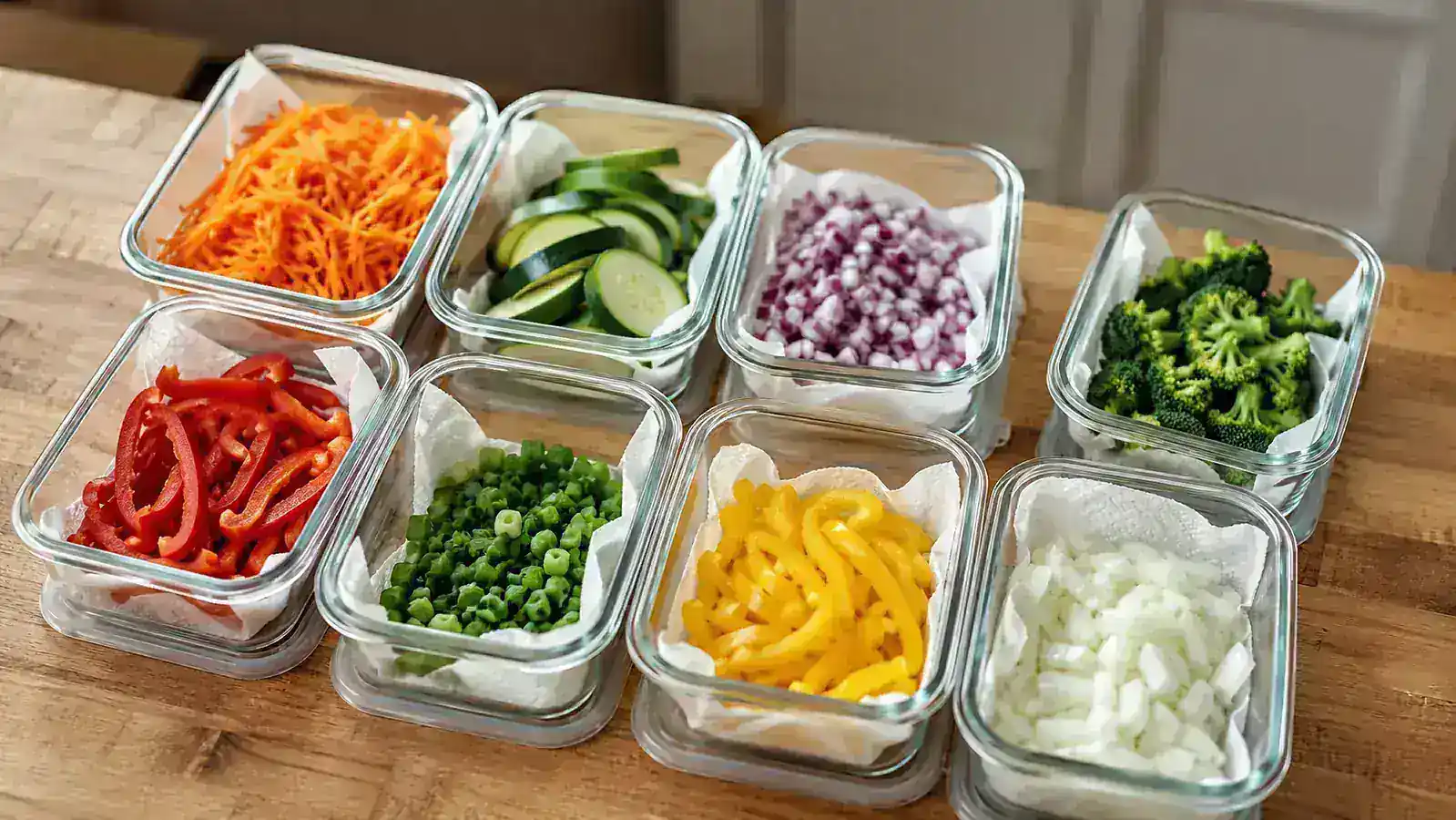
Prepping everything on Sunday only pays off if the vegetables are still good on Thursday. Shredded carrots and cabbage go into airtight containers lined with a paper towel, which pulls out extra moisture and keeps them from turning slimy by midweek. Sliced cucumbers and zucchini don't hold up as well once cut, so I store those with a paper towel too and try to use them within three or four days rather than stretching them to the end of the week. Diced onion goes into its own sealed container, always separate from everything else, because a fridge full of vegetables that all taste faintly like onion is its own kind of disappointing.
I label the lids with a piece of tape and the day I prepped them, which sounds fussy but it's saved me from guessing on a Thursday night whether the shredded carrots are still good. Carrots and cabbage genuinely hold up through six or seven days in a sealed container. Cucumber and zucchini slices are the ones I watch, and if they've gone soft or watery by day four I'll toss what's left rather than serve something that used to be crisp. Onion keeps the longest of anything on this list, easily the full week, which is one more reason to prep a bigger batch of it than you think you'll need.
I wrote up ten specific ways the Cuisinart food processor has sped up my weeknight prep if you want the bigger picture beyond just vegetables, and if you're still deciding whether to buy one at all, my honest review of the Cuisinart food processor covers the parts that took me longer to warm up to, storage and cord length mostly, alongside what's worked well.
What Else Helps
Here's the part I'll be honest about. If I only need one chopped onion for a single recipe tonight, I don't get the Cuisinart food processor out at all. Hauling the base down from the fridge, digging the bowl out of the closet bin, and washing everything after for one onion takes longer than just grabbing a knife and doing it on the cutting board in ninety seconds. The food processor earns its keep on Sunday when I'm running six or seven vegetables through it back to back, not on a Tuesday when I need one thing chopped for one pan. Knowing when to skip it is as useful as knowing how to use it, and I'd rather tell you that plainly than pretend it's the right tool for every single job in the kitchen.
The Cuisinart food processor didn't make vegetable prep disappear, it just moved it all to one Sunday afternoon instead of five separate weeknights, and that trade has been worth every bit of counter space it takes up.
Ready to get your Sundays back?
Once you've got the order and the discs figured out, the Cuisinart 7-Cup Pro Classic Food Processor turns a week of vegetables into one short session. Check today's price and current availability on Amazon.
Amazon Check Today's Price on Amazon →