

Six months ago I hauled a box up two flights of stairs into my galley kitchen and wondered if I'd just spent good money on a machine I'd use twice before it went to live on top of the fridge forever. The Cuisinart 7-Cup Pro Classic Food Processor has been out on my counter, or more accurately hauled out of the hall closet, almost every weeknight since. I have twenty-two inches of usable counter beside my sink in this 1940s upstairs duplex, and every appliance I own has to earn its keep in that strip or lose its spot for good. The Cuisinart earned it, mostly, and the "mostly" is the part worth reading about.
This isn't a first-week impression dressed up as a long-term review. I've shredded blocks of cheese for lasagna, minced enough garlic that my downstairs neighbor probably knows my dinner schedule by now, run pesto through it a dozen times, and mixed two batches of pie dough with the dough blade over the holidays. Six months in, I know exactly what this Cuisinart is good at, and exactly what makes me sigh before I pull the pusher tube back out of the closet bin.
The Quick Verdict
A genuinely powerful 600-watt motor that chops evenly and fast, held back half a point by storage that assumes you have more cabinet space than a duplex kitchen gives you.
Amazon Check Today's Price →Still chopping onions by hand for a fifteen-minute dinner?
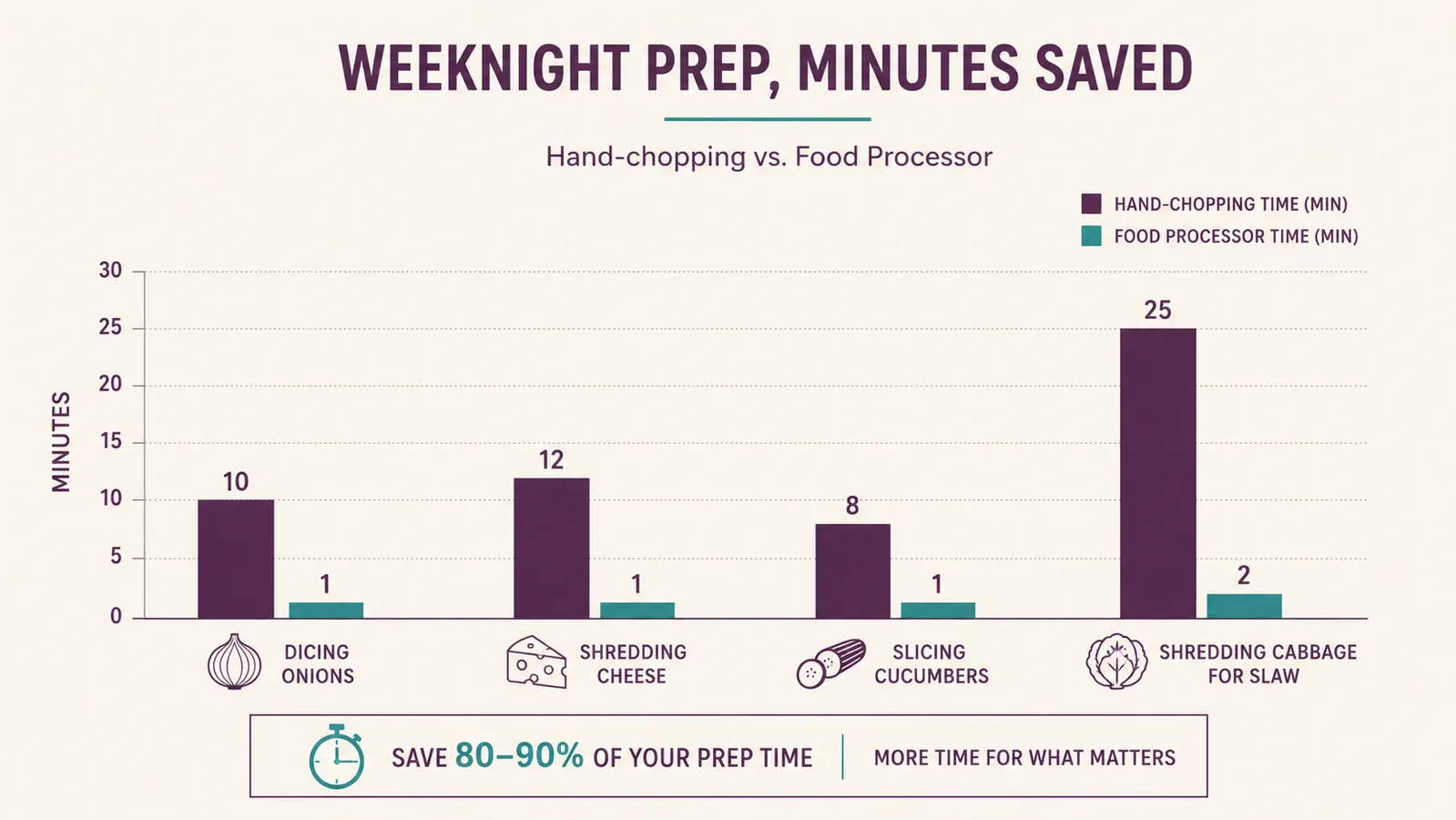
The Cuisinart 7-Cup Pro Classic has cut my weeknight prep time in half without a single uneven dice. See what it's doing today on Amazon before you decide.
Amazon Check Today's Price on Amazon →How I've Used It
I didn't buy the Cuisinart for a single project, I bought it because chopping for two people every single night was wearing down my wrists faster than I liked admitting. Over six months it's handled the boring stuff, onions, carrots, and celery for soup three nights a week, and the stuff I used to avoid because it was tedious by hand: shredding a full block of cheddar for a casserole, turning a head of cabbage into slaw in under a minute, pulsing basil and pine nuts into pesto without babysitting a blender jar.
The dough blade has gotten more use than I expected going in. I make pie dough maybe six times a year, and the Cuisinart cuts cold butter into flour in about eight pulses, which is faster and more even than I ever managed with two knives and a prayer. I've also used the slicing disc for cucumbers and zucchini, and the shredding disc for potatoes when I wanted hash browns without grating my own knuckles along with them.
What it hasn't replaced is my knife for anything where I actually want texture, uneven diced tomatoes for a salad, herbs I want roughly chopped instead of pureed into a paste. The Cuisinart does one texture very well within a given task, but it doesn't do nuance. That's not really a flaw, it's just what a food processor is built for.

The 600-Watt Motor and What It Actually Chops Through
The spec sheet says 600 watts, and across six months of nightly use I've had exactly one moment where I wondered if it was struggling, and that was a wedge of parmesan straight out of the fridge, cold and hard. It got there, but it took longer and sounded strained in a way that a room-temperature block never does. Everything else, onions, carrots, celery, cabbage, soft cheeses, cooked beans for hummus, gets handled without any hesitation at all.
The pulse control matters more than the raw wattage number ever could. I use short pulses for anything I want to control the texture on, salsa, guacamole, pesto, and hold the run button for anything I want fully uniform, like shredded cheese or a smooth hummus base. The Cuisinart blade was sharp enough out of the box that it stayed that way through six months without me sharpening or replacing anything, which honestly surprised me given how often it's run.
If you're weighing this against a stand mixer attachment or trying to figure out whether the extra motor power actually matters day to day, I put together a full Cuisinart food processor vs KitchenAid comparison after running both machines through the same week of meals. The short version is that the Cuisinart's dedicated motor handles dense chopping jobs faster, but that comparison deserves its own read.
The 7-cup bowl is exactly the right size for how I actually cook. It holds a full head of cabbage or two blocks of cheese without needing a second batch, but it isn't so large that washing it feels like scrubbing a stockpot. I looked at the 11-cup model before I bought this one, and I'm glad I didn't. In a kitchen with twenty-two inches of counter, a bigger bowl would have meant a bigger everything, a heavier base, a wider footprint, more of my closet bin taken up by parts I use maybe four times a year.
Storage: Where the Base and Bowl Actually Live
This is the part of owning a Cuisinart that nobody puts in a five-star review. The base is heavy, heavier than I expected from the box, and it lives on top of my fridge because there's nowhere else for it in a duplex kitchen this size. Getting it down every night is a two-hand job, and putting it back up there with wet hands after cleanup is the single most annoying part of owning this machine.
The bowl, lid, blade, and the two discs live in a bin in my hall closet, which means using the Cuisinart on a weeknight is never a thirty-second decision. It's climb on a step stool for the base, dig through the closet bin for the bowl and blade, assemble everything on the twenty-two inches of counter beside my sink, and only then start chopping anything at all. On a night when I'm already tired, that setup time is sometimes the difference between using it and just reaching for a knife instead.
The plastic case that holds the two discs has a hinge that's gotten looser over six months of opening and closing it several times a week. It still closes, but I've started storing it with a rubber band around it because I don't fully trust the latch anymore. That's a small thing on its own, but small things are exactly what six months tells you that six days never could.
Cleanup After Six Months of Daily Use
The bowl, lid, and discs are dishwasher safe on the top rack, and I ran them through the dishwasher for the first month before I gave up and started hand washing everything instead. Part of that is space, my dishwasher is small and a food processor bowl takes up real rack space I usually need for actual plates. Part of it is that the blade is genuinely sharp enough to want careful handling, and I don't love reaching into a crowded rack of cutlery to find it by feel.
Hand washing the Cuisinart bowl takes about ninety seconds if I do it right after I use it, and closer to five minutes if I let cheese or dough dry onto the blade first, which I have done more than once at eight at night with a sink already half full of dinner dishes. The base itself just needs a wipe down, it doesn't submerge, which is one less thing to worry about given how little counter space I have left over for drying anything.
The two discs are the part I forget to wash right away, since they don't look dirty until I run water over them and find shredded carrot wedged in the slicing teeth. I keep a small brush by the sink now just for those slots, because a sponge alone doesn't reach into the disc's cutting edge, and skipping that step for even one night makes the next wash take twice as long.
What I Considered Before Buying This One
Before I settled on the Cuisinart, I looked at a mini three-cup chopper that could live on the counter permanently, and a full-size 14-cup model a friend swears by for holiday cooking. The mini chopper was too small for anything beyond mincing garlic, I'd have needed three batches just to get through a single pot of soup. The 14-cup model would have needed its own shelf, not just a spot on top of the fridge, and I don't have a spare shelf to give it.
The 7-cup landed in the middle, big enough to handle real weeknight cooking for two people, small enough that the base still fits on top of my fridge without hanging over the edge. If I were cooking for a family of five I'd probably feel differently about the capacity, but for the way I actually cook, this size has been right every single week for six months straight.
The Outlet Problem
My kitchen has one outlet cluster beside the sink, and every appliance I own competes for it. The Cuisinart's cord is on the shorter side, which means it has to sit close to that outlet, which means it's fighting for the same six inches of counter as my kettle and my toaster on any morning I'm making breakfast and prepping lunch at the same time. This isn't unique to the Cuisinart, most countertop appliances have this problem in a kitchen this size, but it's worth knowing before you decide where yours is going to live.
I ended up buying a short, flat power strip just to give the Cuisinart, the kettle, and the toaster their own plugs without unplugging one to use another mid meal. It's a small, cheap fix, but it's also the kind of thing nobody mentions in a spec sheet, and it only becomes obvious once you're standing there at six in the morning trying to make coffee and toast while a base you just carried down is sitting there waiting for its turn at the only outlet in the room.

What Six Months Revealed That the First Week Didn't
The feed tube is narrower than I expected for slicing whole cucumbers or zucchini, so I end up halving them lengthwise before they'll drop through, which adds a step I didn't budget for the first time I used the slicing disc. It's a small annoyance that shows up almost every time I reach for that disc, and after six months it has added up to real irritation even though it only costs ten extra seconds.
Noise is the other thing I didn't fully register in week one. On dense jobs, cold parmesan, a full load of carrots, the Cuisinart is loud enough that I don't run it before eight in the morning out of consideration for the unit below mine. It's not louder than most food processors in this price range, but in an upstairs duplex with thin 1940s floors, I notice it far more than I would in a detached house with a real basement between me and a neighbor.
For anyone curious what a normal week of using this thing actually looks like task by task, I wrote up ten specific ways the Cuisinart has sped up my prep, pulled directly from six months of real dinners, not a single afternoon of testing everything at once.
What I Liked
- 600-watt motor chops evenly through everything from soft cheese to raw carrots without bogging down
- Dough blade cuts cold butter into flour faster and more consistently than doing it by hand
- Blade held its edge through six months of near-daily use with no sharpening needed
- Pulse control makes it easy to stop at the exact texture I want for salsa or pesto
- Bowl and discs are dishwasher safe on the top rack when I have the space to use it
Where It Falls Short
- Base is heavy enough that storing it anywhere but the top of the fridge isn't realistic in a small kitchen
- Feed tube is too narrow to drop a whole cucumber or zucchini through without halving it first
- Disc storage case hinge has loosened after months of regular use
- Short cord keeps it tied to the one outlet cluster in my kitchen, competing with the kettle and toaster
- Loud enough on dense jobs that I avoid running it early in the morning
Six months in, the Cuisinart hasn't changed how I cook, it's just changed how long cooking takes on a Tuesday, and that's the only kind of change that actually sticks.
Who This Is For
The Cuisinart makes sense if you cook most nights and you're tired of the ten minutes of knife work that stand between you and dinner actually starting. It's also worth it if you bake more than a few times a year and want a dough blade that handles butter and flour better than your own hands do on a hot day. If you have a spot for the base that isn't a step stool away, even better, that alone will change how often you reach for it.
Who Should Skip It
If you cook a couple of nights a week and mostly reach for a knife anyway, the setup and cleanup time on the Cuisinart will probably outweigh what it saves you. It's also not the right fit if you don't have anywhere to store a base this heavy, because a food processor that lives permanently out on the counter is a different kind of purchase than one you haul out and put away again, and my twenty-two inches beside the sink couldn't spare it full time even if I wanted it to.
Ready to stop dicing onions by hand every night?
After six months of near-daily use, the Cuisinart 7-Cup Pro Classic is still the appliance I reach for first. Check today's price and current availability on Amazon.
Amazon Check Today's Price on Amazon →