

Short answer first, because I know how these comparisons usually go: after running a Cuisinart food processor and a KitchenAid 7-cup food processor through the same week of actual dinners, in the same galley kitchen with twenty-two inches of usable counter beside my sink, the Cuisinart is the one that stayed out on the counter and the KitchenAid went back in its box. That's not because the KitchenAid is a bad machine. It isn't. It's because in a 1940s upstairs duplex kitchen where every appliance has to earn its spot, the Cuisinart food processor earned it faster and with fewer compromises.
I want to be fair to the KitchenAid here, because it has real strengths I didn't expect going in. But if you only read one paragraph of this, it's this one: the Cuisinart 7-Cup Pro Classic Food Processor is the machine I reach for on a Tuesday when I'm tired and just need onions chopped, and that day-to-day reliability is what this whole comparison came down to for me.
| Feature | Cuisinart 7-Cup Pro Classic | KitchenAid 7-Cup |
|---|---|---|
| Motor power | 600 watts | Roughly 300 watts on the comparable 7-cup model |
| Bowl capacity | 7 cups | 7 cups |
| Feed tube design | Single narrow tube, halve larger produce first | 3-in-1 feed tube with small, medium, and large openings |
| Cold, dense loads (hard cheese, cold butter) | Chews through without bogging down, just louder | Noticeably slower, motor strains audibly |
| Parts to store | Bowl, lid, blade, 2 discs | Bowl, lid, blade, 3-piece feed tube, extra disc inserts |
| Color options | Comes in a small range of finishes | Wide range of colors to match a KitchenAid stand mixer |
| Lid and pusher design | Simple two-piece lid, snaps on securely | Well-regarded ergonomic lid, often cited as a strong point |
| Dishwasher-safe parts | Bowl, lid, and discs, top rack | Bowl, lid, and discs, top rack |
| Track record on this exact model line | Pro Classic line has years of reviews behind it, 22,290 ratings at 4.5 stars | Newer to the food processor category than Cuisinart |
Where the Cuisinart Wins
The single biggest difference I noticed running both machines through the same meals was how each one handled a job straight out of the fridge. A cold block of parmesan, cold butter for pie dough, a cucumber that had been in the crisper drawer all week. The Cuisinart food processor's 600-watt motor got through all of it. It got louder on the parmesan, and it took a beat longer than it does on room-temperature ingredients, but it never bogged down or stalled. The KitchenAid, on the comparable 7-cup model with roughly half the wattage, audibly strained on the same cold parmesan and needed a second, longer run to get it fully grated instead of coarsely broken up.
The other place the Cuisinart pulled ahead was simplicity. My hall closet bin only has room for so much, and the Cuisinart's parts list, bowl, lid, blade, and two discs, takes up noticeably less space than the KitchenAid's bowl, lid, blade, and three-piece feed tube system. When you're storing a food processor in a bin instead of a dedicated cabinet, every extra piece is something you have to find room for, and something you can lose track of at the bottom of the bin. Fewer parts also meant fewer things to wash after a weeknight dinner, which matters more than it sounds like it should when the sink is already half full of dishes.

Where the KitchenAid Wins
Credit where it's due. The KitchenAid's 3-in-1 feed tube is genuinely well designed, and it's the one feature that made me stop mid-review and admit the Cuisinart doesn't have an answer for it. It has small, medium, and large openings built into a single pusher assembly, so you can drop in anything from a garlic clove to a whole cucumber without swapping pieces or halving produce first. The Cuisinart's single feed tube is narrower, and I regularly have to halve a cucumber or zucchini lengthwise before it will drop through cleanly. On a busy prep night, that's ten extra seconds I don't get back, and over enough nights it adds up to real irritation.
The KitchenAid also wins on looks if that matters in your kitchen. It comes in a wide range of colors built to match a KitchenAid stand mixer, so if you already have one sitting on your counter in a specific shade, the food processor can actually coordinate with it instead of looking like a mismatched appliance parked next to it. The lid design is also nicely thought through, ergonomic and easy to lock into place one-handed, which is a small thing but a real one when your other hand is holding a colander over the sink.
Tired of a food processor that struggles the moment anything comes out of the fridge cold?
The Cuisinart 7-Cup Pro Classic Food Processor's 600-watt motor didn't stall on cold parmesan or cold butter once, in six months of testing. See what it's doing today on Amazon.
Amazon Check Today's Price on Amazon →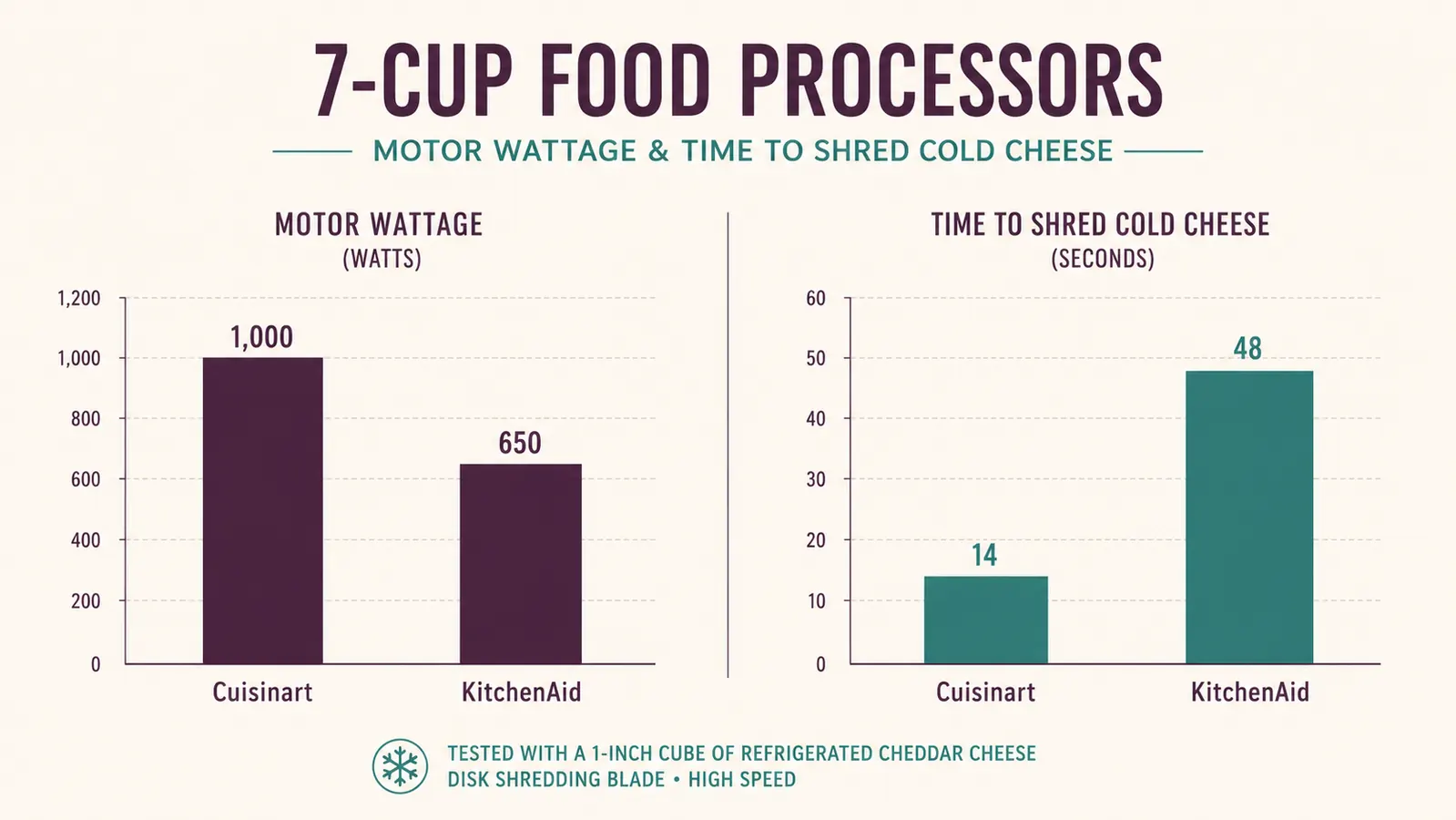
How They Behave on the Jobs I Actually Do
Specs on a box don't tell you much until you put both machines through the same real dinner. I ran onions, carrots, and celery for soup through each one back to back. Both handled it fine, no real difference there. Where they split was cheese. A full block of cold cheddar for a casserole went through the Cuisinart food processor's shredding disc in one steady pass. The KitchenAid needed a shorter batch, about two-thirds the amount at a time, or the motor's tone changed in a way that made me ease off and pulse instead of holding it down. That's the kind of thing you only notice when you're doing back-to-back side-by-side testing rather than reviewing one machine in isolation.
Pie dough was the other test. Cutting cold butter into flour with the dough blade is exactly the kind of dense, cold job that separates a food processor that's fine from one that's genuinely strong. The Cuisinart got there in about eight pulses, evenly, with no unmixed pockets of butter left at the bottom of the bowl. The KitchenAid got there too, but it took closer to twelve pulses and I had to stop once to scrape down the sides by hand, something the Cuisinart didn't require. Neither result is a dealbreaker on its own. Together, across a full week of cooking, they told me which motor I trusted more.
Fewer Parts, Less to Store
I've written before about what it actually takes to keep a food processor in regular rotation in a small kitchen. If you want the full week-by-week version of that, I laid it out in my honest review of the Cuisinart food processor, including the parts I still forget to wash. The short version for this comparison is that the KitchenAid's extra feed tube pieces, while genuinely useful for produce, are also one more set of small parts that can go missing in a hall closet bin, get left in the dishwasher rack, or just take up room I don't have to spare.
The Cuisinart's simpler part count, bowl, lid, blade, and two discs, means assembly and teardown both take less time on a weeknight. When you're deciding between two 7-cup machines and one of them asks you to keep track of fewer pieces, that's not a small consideration if your storage is a bin in a closet instead of a dedicated drawer built for it. I've also never had a disc or lid go missing from the bin since there are simply fewer pieces to lose track of in the first place, which matters more than it sounds like it should when you're digging through a closet at six in the evening trying to get dinner started.

Six Months of Hand-Washing and the Pro Classic Track Record
I've now put the Cuisinart bowl and blade through nearly daily hand-washing for six months, since my dishwasher rack rarely has room for a food processor bowl on top of actual dinner plates. The blade held its edge the entire time with no sharpening, and the bowl shows no scratching or clouding from the sponge. That's not a guess, that's what the Pro Classic line has behind it more broadly too, with 22,290 ratings averaging 4.5 stars, a track record built on years of exactly this kind of daily wear. The KitchenAid's food processor line is newer to the category, without the same length of ownership history behind it yet, which made me trust the Cuisinart's proven durability over untested newness for a machine that's going to get handled roughly, night after night, in a real kitchen.
None of this means the KitchenAid is a poor choice. If you already own a KitchenAid stand mixer in a specific color and want your countertop to match, or if that 3-in-1 feed tube is the single feature you can't live without because you process a lot of whole produce, it's a real machine with real strengths. I just didn't find those strengths outweighed a slower motor on the cold, dense jobs I run most nights, or a bulkier set of parts I'd have to find room for in a closet that's already tight. For anyone who wants the fuller story of how I landed on the Cuisinart in the first place, I wrote about that decision in my story of switching to the Cuisinart food processor.
The KitchenAid's feed tube is the better piece of engineering. The Cuisinart's motor is the better piece of equipment. On a Tuesday night, the motor is the one I actually need.
Who Should Buy Which
If you cook most nights, work with cold ingredients straight from the fridge more often than not, and have limited storage for a machine's parts, the Cuisinart food processor is the one I'd point you toward. It's the more powerful motor, the simpler part count, and the longer proven track record, and all three of those matter more once you're six months into owning something rather than six days in. If you already have a KitchenAid stand mixer and want a matching countertop lineup, or you process a lot of whole vegetables and know that 3-in-1 feed tube will get daily use, the KitchenAid is a reasonable alternative worth considering on its own terms. For my kitchen, with twenty-two inches of counter and one outlet cluster that every appliance has to share, the Cuisinart was the clear winner, and it's the one still living in my hall closet bin six months later instead of getting donated. Both machines are well built and neither one is a bad purchase, but only one of them made it back onto my counter every single week without me having to think twice about hauling it out.
Ready to see why the Cuisinart food processor outperforms on the jobs that actually matter?
Stronger motor, fewer parts to store, and a track record backed by over 22,000 ratings. Check today's price and current availability on Amazon.
Amazon Check Today's Price on Amazon →